
Monday, September 23, 2013
The Tooth Extraction Process
In today's best dental practices, dentists try to save their patients natural teeth. Although the technology in the dental industry has improved immensely, there are still some instances where a Denver dentist cannot save a tooth. A simple extraction is usually done by a dentist and more complicated extractions are usually performed by a more experience oral surgeon.
 During a tooth extraction, a dentist will use anesthesia so you do not feel any pain during the procedure. They may also put their patients 'under' with IV sedation.

Sunday, September 22, 2013
Tips for Good Oral Hygiene
Bacteria can live in your mouth in the form of plaque, causing cavities and gingivitis, which can lead to periodontal (gum) disease. In order to keep your mouth clean, you must practice good oral hygiene every day.
What is plaque?
Plaque is a sticky layer of material containing bacteria that accumulates on teeth, including where toothbrushes can't reach. Many of the foods you eat cause the bacteria in your mouth to produce acids. Sugary foods are obvious sources of plaque, but there are others that you might not realize can cause harm. Starches—such as bread, crackers, and cereal—also cause acids to form. Plaque also produces substances that irritate the gums, making them red, sensitive, and susceptible to bleeding. This can lead to gum disease, in which gums pull away from the teeth and form pockets that fill with bacteria and pus. If the gums are not treated, the bone around the teeth can be destroyed and teeth may become loose or have to be removed.

How do I brush and floss my teeth?
The American Dental Association recommends the following techniques for brushing and flossing your teeth:
Brushing
• Place your toothbrush at a 45-degree angle against the gums.
• Move the brush back and forth gently in short (tooth-wide) strokes.
• Brush the outer tooth surfaces, the inner tooth surfaces, and the chewing surfaces of the teeth.
• Use the tip of the brush to clean the inside surfaces of the front teeth, using a gentle up-and-down stroke.
• Brush your tongue to remove bacteria and freshen your breath.
Monday, September 16, 2013
Dental Implants INFOGRAPHIC
Here is a great INFOGRAPHIC on dental implants. There is a ton of great information about the different types of dental implants, the procedures and their benefits. Getting an implant is a great solution for permanent tooth replacement. Unlike dentures that can move as you talk - implants look and act like a natural tooth.

Thursday, August 22, 2013
Dental Care for your Dog
I know, I know - a pet dental care blog posts but I figured it was kind of fitting... Here's a good article about dental care for your dog I found on Hubpages written by eastcoastone.
 Looking for a sure fire way to make your dog sick simply ignore it’s dental care. As in people, neglect in dental care may cause illness in other parts of the body.
Studies that began on the late 1990’s in people have shown that the same bacteria that causes, gingivitis, gum disease, and or simple tarter or calcium buildups. Can lead to heart disease and diabetes. In dogs oral bacteria enters the blood stream and ends up in the heart as a calcium buildup or hardening of the arteries.
While nothing beats a complete cleaning at the veterinarian, the $400.00 to $600.00 bill you will receive at the end of the procedure, will probably cause hardening off your arteries. As well and understandably many people are not comfortable having their pet go under anesthesia for a simple cleaning. I do recommend having your dogs teeth cleaned if it is already going under anesthesia for a different problem. This will highly reduce the cost of the cleaning, due to the fact that a majority of the cleaning cost is in the anesthesia. It only cost my dog an extra $190.00 to have her teeth cleaned on top of a procedure she was already having.
Dog Dental Care And Dental Maintenance

Studies that began on the late 1990’s in people have shown that the same bacteria that causes, gingivitis, gum disease, and or simple tarter or calcium buildups. Can lead to heart disease and diabetes. In dogs oral bacteria enters the blood stream and ends up in the heart as a calcium buildup or hardening of the arteries.
While nothing beats a complete cleaning at the veterinarian, the $400.00 to $600.00 bill you will receive at the end of the procedure, will probably cause hardening off your arteries. As well and understandably many people are not comfortable having their pet go under anesthesia for a simple cleaning. I do recommend having your dogs teeth cleaned if it is already going under anesthesia for a different problem. This will highly reduce the cost of the cleaning, due to the fact that a majority of the cleaning cost is in the anesthesia. It only cost my dog an extra $190.00 to have her teeth cleaned on top of a procedure she was already having.
Wednesday, August 21, 2013
What Happens When A Tooth Dies?
It does not matter what actually causes a tooth to die, a patient usually feels little to no pain and will show no signs of an infection. As the nerve of the tooth dies, toxins are released from the necrotic tissue. Slow bone destruction is processed in the chronic state and an actual holding area or void will start to fill with material. Toxins will then be picked up and carried throughout the body through the blood stream resulting in a slow death.
 Most patients won't know right away that damage done to a tooth will result in it's death. Slowly the tooth will appear darker and a dental x-ray will show a void or a dead pulp center chamber in the tooth. Once this happens, the tooth is considered 'Abscessed'. Once a tooth with an abscess is removed you will usually find a cyst as the body created to try and contain the infection.
The picture on the right shows a tooth abscess and infected bulp. The tooth decay began in the enamel of the tooth and spread to the pulp.
In an acute situation, no void or holding area exists large enough to accommodate the large quantity of purulent matter.

The picture on the right shows a tooth abscess and infected bulp. The tooth decay began in the enamel of the tooth and spread to the pulp.
In an acute situation, no void or holding area exists large enough to accommodate the large quantity of purulent matter.
Tuesday, August 20, 2013
How To Pay for your Dental Work
Post written by: chmkadmin
Paying for dental care is a actually much easier than you might think. Since dental insurance is not nearly as ubiquitous as health insurance (many employers provide limited plans, if anything at all), many dental offices must operate under the assumption that a large percentage of their patients are not covered. Believe it or not, this helps keep the prices much lower than they would be otherwise.
 Let's get one thing out of the way early on - outside of regular cleanings and checkups, dental care still is not cheap. Tooth extractions, root canals, fillings, etc... can run several hundred dollars or more per procedure. That said, you will end up paying less in the long run if you follow preventative guidelines, paying for the inexpensive bi-annual cleanings.
The biggest factor that works to your advantage is that a local dentist's office wants and cares about your business! That's right, as dentists are not typically governed by some large consortium or group (there are some exceptions) and operate as small businesses, they are much more open to keeping you happy as a customer. Additionally, most dentists are very upfront on the cost of procedures before you get them done. Although you may have a good personal relationship with your doctor as well, your doctor likely does not handle all billing internally (there are exceptions of course), and may not be aware of your ability to pay or not to pay. Additionally, because of the heavy influence of insurance, doctors will not typically post a fee schedule for rendered services beyond the cost of an office visit. This can lead to big problems if you wind up with a bill that's unexpected - whether you have insurance or not. Worse, billing can be so bad from doctors offices - that the first bill you might receive will be from a collection agency. Bad news.
Paying for dental care is a actually much easier than you might think. Since dental insurance is not nearly as ubiquitous as health insurance (many employers provide limited plans, if anything at all), many dental offices must operate under the assumption that a large percentage of their patients are not covered. Believe it or not, this helps keep the prices much lower than they would be otherwise.

The biggest factor that works to your advantage is that a local dentist's office wants and cares about your business! That's right, as dentists are not typically governed by some large consortium or group (there are some exceptions) and operate as small businesses, they are much more open to keeping you happy as a customer. Additionally, most dentists are very upfront on the cost of procedures before you get them done. Although you may have a good personal relationship with your doctor as well, your doctor likely does not handle all billing internally (there are exceptions of course), and may not be aware of your ability to pay or not to pay. Additionally, because of the heavy influence of insurance, doctors will not typically post a fee schedule for rendered services beyond the cost of an office visit. This can lead to big problems if you wind up with a bill that's unexpected - whether you have insurance or not. Worse, billing can be so bad from doctors offices - that the first bill you might receive will be from a collection agency. Bad news.
Thursday, August 1, 2013
Improving Gum Health With Scaling and Proper Care
Scaling means scraping away. You can scale old food, tartar, or even particles caught under the gum. You usually scale teeth to remove tartar and prevent gum disease. Tartar occurs when a coating of germs hardens on the teeth. Gums press against the tartar build up, and they become sore and infected. Clean teeth help to ensure that your gums stay healthy. Scaling teeth clan help make infected gums healthy again. However, gums can only remain healthy when the teeth are cleaned regularly. If teeth are not cleaned thoroughly and regularly, the tartar will quickly return and infect the gums again.
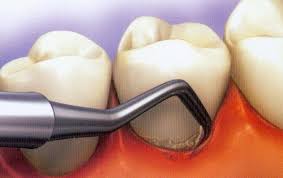
If you have bleeding of the gums increase the number of times a day you brush and add a rinse of warm salt water to your oral hygiene routine. This will help your gums heal quickly. Have your teeth cleaned as soon as you can to avoid more serious gum health problems. Scaling the teeth will be much easier and more effective after improving your gum health. Have your dentist use their mirror to show you the gum infection in your mouth. After care and proper hygiene, you'll be able to see how much you can improve your gum health with proper dental care.
What is used to Scale Teeth?
Lone Tree dentists say, scaling is done with special instruments called scalers. There are many different types of scalers for different jobs. The most popular scalers are the Ivory C-1 scaler and the G-11 and 12 curette. These two scalers can be used on most of the teeth of your mouth. The Ivory C-1 has two pointed tips to remove tartar from the part of the tooth near the gum. The curette has blunt rounded ends to remove tartar from the part of the tooth under the gum. The ends of the scaler are the most important part to complete the job. One end is bent to the left and the other end is bent to the right, so you can more easily reach all sides of the tooth. The blades at each end of the scalers id sharp so it can easily break apart the tough tartar on the tooth. Other important dental tools used to properly scale the teeth is a mirror, explorer and dental tweezers.
If you have bleeding of the gums increase the number of times a day you brush and add a rinse of warm salt water to your oral hygiene routine. This will help your gums heal quickly. Have your teeth cleaned as soon as you can to avoid more serious gum health problems. Scaling the teeth will be much easier and more effective after improving your gum health. Have your dentist use their mirror to show you the gum infection in your mouth. After care and proper hygiene, you'll be able to see how much you can improve your gum health with proper dental care.
What is used to Scale Teeth?
Lone Tree dentists say, scaling is done with special instruments called scalers. There are many different types of scalers for different jobs. The most popular scalers are the Ivory C-1 scaler and the G-11 and 12 curette. These two scalers can be used on most of the teeth of your mouth. The Ivory C-1 has two pointed tips to remove tartar from the part of the tooth near the gum. The curette has blunt rounded ends to remove tartar from the part of the tooth under the gum. The ends of the scaler are the most important part to complete the job. One end is bent to the left and the other end is bent to the right, so you can more easily reach all sides of the tooth. The blades at each end of the scalers id sharp so it can easily break apart the tough tartar on the tooth. Other important dental tools used to properly scale the teeth is a mirror, explorer and dental tweezers.
Subscribe to:
Posts (Atom)